Wednesday, August 14, 2024

“Fear” by James Warner Bellah


“Afraid? Who isn’t afraid? But it doesn’t do any good to brood over it.”

James Warner Bellah, the author of many a fine Cavalry tale, those fine enough to be adapted to the screen by the late great John Ford, here brings his military insight to a World War I flying squadron.

We have a tale of a newly arrived pilot learning the ropes of combat in the days of canvas covered wood framed biplanes.

Bellah’s history is accurate. His feel for the realities of “being in the mix” of combat are just as sure as his cavalry work.

This is essentially Red Badge of Courage of the skies.

We live inside the head of the new arrival. Does he or doesn’t he have what it takes to do what must be done in battle?

His struggles are real. His tightrope walk of cowardice and duty are just as tangible.

Those looking for the surface charms of superhuman exploits such as found in Lee Child, Jack Carr, Mark Greaney et al. may not like what they find here.

Here is no superhuman—here we have nothing but humanity—fearful and yet plodding on.

For duty? Maybe not.

“Our job is a funny one, and we’re not here for ourselves, and were not here to be heroes or to get in the newspapers. The V. C.’s [Victoria Crosses] are few and far between.” He raised himself upon his elbow. “I’m not preaching self-abasement and a greater loyalty to a cause that is right, mind you. I don’t know anything about causes or who started the war or why, and I don’t care. I’m preaching C Flight and the lives of five men.”

Bellah nails what most true accounts understand, incredible feats of heroism and what we might term patriotic fervor are often more microcosmic than that. It is duty, loyalty, respect and, I’ll say it, love, for the flesh and blood right there in the trenches with you. The man or woman beside you. The “Big Cause” fades, the meme/headline/creed du jour dissipates.

Slogans and cheers are surface costumes for a character we haven’t stepped up to in actuality.

Whereas the person next to you in a struggle is bone-deep and real.

The men in this story live on that edge—an edge of “We are scared as hell, but let’s not dwell on it.”

Cruel, thin, casual talk clicking against their teeth in nervous haste; the commercial talk of men bartering their lives against each tick of the clock; men caught like rats in a trap, with no escape but death or a lucky chance like Mallory’s. Caught and yet denying the trap—laughing at it until the low roof of the mess shack rumbled with the echo; drowning it in whisky for the night.

These men are no Mitch Rapp. No Jack Reacher.

They are real men and all the more heroic for it.

Every sentence of Mr. Bellah’s prose flavors the mood.

“The cold wet mist lay upon the fields like a soft veil drawn across the face of an old woman who had died in the night.”

A work of adult action, written by a mature mind for mature minds.

And the lesson holds for us all.

Afraid? Who isn’t afraid” But it doesn’t do any good to brood over it.”

Tuesday, August 6, 2024

Bad Blood by John Sandford


Virgil went out the door, feeling a cop-like elation: he had them. But even as he went, he thought, Should I be happy that I was right, and that children are being abused? So he said that to Jenkins: “I got this rush, you know, being right about this. Being right about kids getting abused.”

“That’s not why you got the rush,” Jenkins said. “You got the rush because we’re going to stop it.”

“That’s right,” Virgil said. “I like your reconceptualization.”

“I’m really good at that,” Jenkins said. “Let me get some stuff out of Shrake’s trunk.”

What he got out of Shrake’s trunk were a bulletproof vest and two M16s with low-light Red-Dot scopes and ten thirty-round magazines. “I brought one for you, if you want it,” he said.

“Might be a little overgunned,” Virgil said.

Jenkins said, “I’ve never been overgunned. I have been under-gunned. After that happened, I reconceptualized.”

The third “not a Western” by John Sandford I’ve offered here. I justify as it is in the realm of rural cop/police procedural that works by Craig Johnson and C.J. Box often float under the radar with.

Box and Johnson are both fine writers, but it strikes me that Sandford is the brisker and sturdiest of them all. Add to that, a procedural verisimilitude no doubt furnished by Sandford’s years as a crime reporter, and you have rock-solid work.

This is another in the rural Minnesota, Virgil Flowers series. Speedy entertainment for those who don’t mind their Law Dogs of more recent vintage and remind themselves that many a fine Western is set in the wilds of Minnesota, so why not this modern incarnation?

I repeat, rock solid stuff. 

Wednesday, July 31, 2024

The Last Kind Words Saloon by Larry McMurtry


Bat Masterson claims you're the best pistol shot in the West,” Doc said. “He says you can hit a coyote at four hundred yards.”

“Hell, I couldn't even see a dang coyote if it was that far away, unless they painted it red,” Wyatt said. “Bat should let me do my own bragging if he can't manage to be credible.”

“All right then, what's the furthest distance you could hit a fat man?” Doc persisted, determined to get at least the elements of conversation out of the taciturn Wyatt, who ignored the question.

Here we have the esteemed Mr. McMurtry’s last western. It is a slim volume in comparison with his epic work.

Slim in scale but not necessarily in scope of inclusion.

McMurtry has packed the tale with real life personages, from Wyatt Earp, to Doc Holliday, to Buffalo Bill, Quanah Parker, Charlie Goodnight and many many more.

The people may have existed and some of the situations are true but, the author has seen fit to fiddle with timelines, meetings and events to suit his whim.

It reminds me of Quentin Tarantino killing Hitler in Inglorious Basterds or likewise killing Manson in Once Upon a Time in Hollywood; the people are real, as is some of the history, but clearly, not all of it.

McMurtry calls this work a “ballad in prose whose characters are afloat in time.”

It may not match the power of the Lonesome Dove quartet of novels, but there is more than enough of the McMurtry talent on display for fans of the man to go along with his joshing of history.

Brief, definitely McMurtry, and I enjoyed the hell out of it.

Tuesday, July 23, 2024

Film Spotlight: Tin Star


Hickman: As long as you're wearing that badge, you got to walk up, tell ‘em to throw ‘em up, then watch which way his hands move. They go up, you got yourself a prisoner. They go down, he's dead...or you are. A decent man doesn't want to kill. But if you're going to shoot, you shoot to kill.

That’s bounty hunter, Morg Hickman [Henry Fonda] to a neophyte sheriff played by Anthony Perkins.

This Anthony Mann directed Western acts as a study in how to be aware, how to be a lawman, how to be awake, and how to be appreciative.

A tight script by Dudley Nichols and superlative direction by Anthony Mann [note the composition of each shot.] Each set-up is well considered. If we note the first shot and the last shot are framed the same as narrative bookends; it lets us know we are in the hands of an artist, a craftsman who has given loving thought to the material at hand.

Henry Fonda is low key but terrific as the loner, his B-story with a widow and her son have the stuff of true sincerity about it.

This role seems a sort of template for his 2-season run as Chief Marshal Simon Fry in the 1959-61 TV series The Deputy.

Also strong is Anthony “Norman Bates” Perkins as the young sheriff, and John McIntire as the town doc.

BTW-The young widow is played by Betsy Palmer, some may know her as Jason Voorhees mother in the original Friday the 13th. See her here when she got to play in better fare.

Fans of Westerns will enjoy.

Fans of lawman wisdom, doubly so.

Come for the story, the lessons, the heart and revel in the craft of each shot composition.

While not a classic in the old school sense, stack it up against any mass produced “action” flick today, and well, you got yourself a bonafide mature piece of art right here.

Wednesday, July 17, 2024

Ford County: Stories by John Grisham


Clanton's most ambitious hustler was a tractor dealer named Bobby Carl Leach. From a large gravel sales lot on the highway north of town, Bobby Carl built an empire that, at one time or another, included a backhoe and dozer service, a fleet of pulpwood trucks, two all-you-can-eat catfish cabins, a motel, some raw timberland upon which the sheriff found marijuana in cultivation, and a collection of real estate that primarily comprised empty buildings scattered around Clanton. Most of them eventually burned.

A collection of short fiction by the noted author of legal thrillers. This one scoots under the Western radar for the short story “Casino” a modern tale of scammery surrounding an Indian Reservation casino.

I’ve read a few of Mr. Grisham’s legal thrillers in the past and liked them. This is his foray into short fiction. Some legal. Most not. All set in the same Southern County. 

The man has an eye and an ear. The people ring true.

The stories?

Some are cynical, some are rambunctious with redneck riotous behavior, some are a gut-punch.

I cried at the last one.

This book tells me I need to re-evaluate the man.

Superlative stuff.

Thursday, July 11, 2024

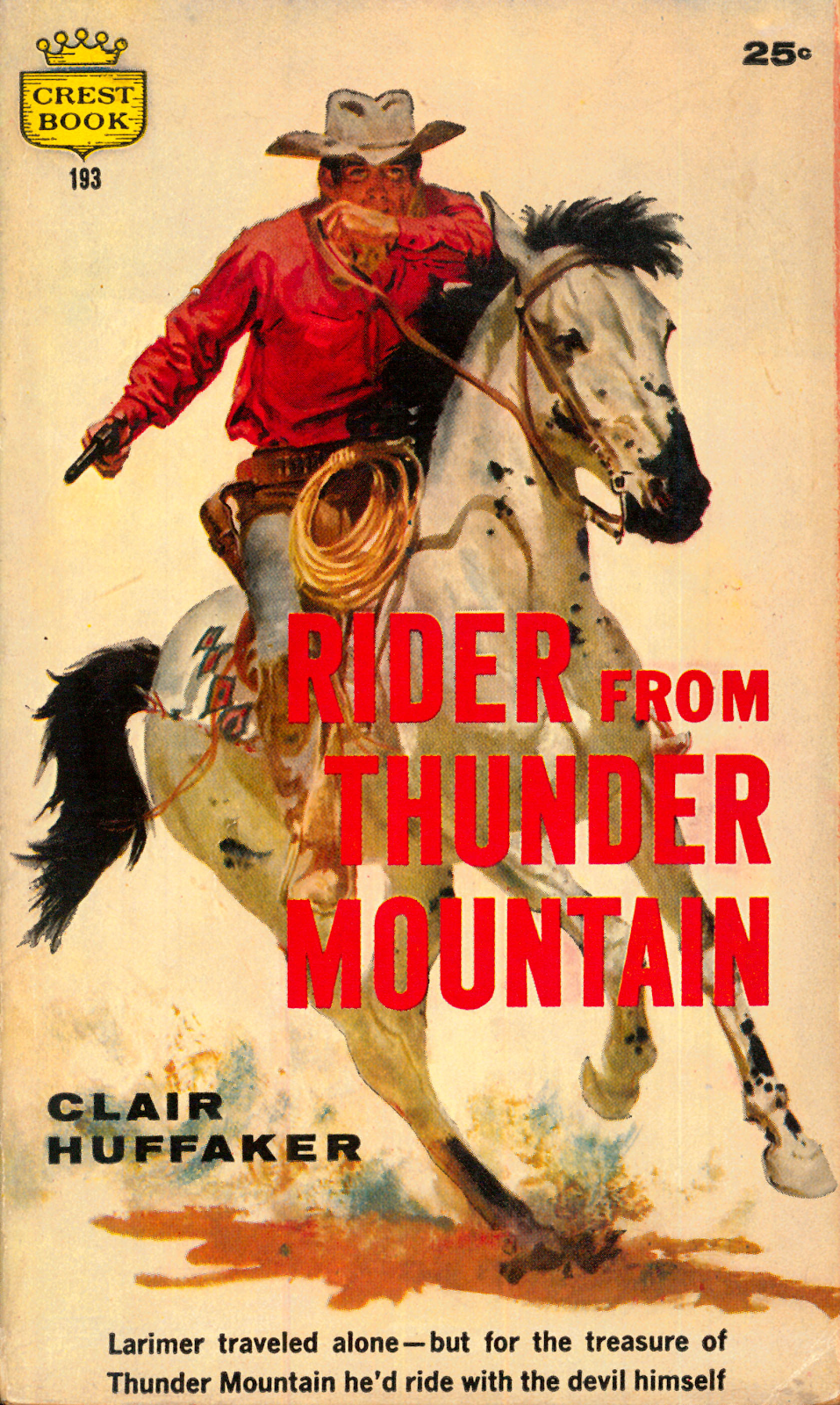
Rider from Thunder Mountain by Clair Huffaker


Still staring down at the Indian camp, Kamas said “What can they do to a man to keep him shrieking like that?”

Larimer crossed his arms in the top of the dirt and embankment and leaned forward. “Quite a few things.”

Kanas seemed frozen where he stood. “I didn't think a man like Tronco would break that way--so fast.”

“White babies learn early that if they yell long enough and loud enough somebody’ll do something for them. Indian kids learn yellin’ brings the wolves down on them, or a hand over their mouth and nose to stop their breathing. Maybe that's somethin’ to do with it.”

This 1957 Fawcett Crest novel is a brisk 128 pages.

It reads swift, lean and mean.

It starts out formulaic, and perhaps never leaves formula behind but we are in such capable hands that formula turns from familiar brew to whiskey neat.

Even with its brisk pace and action-laden plot, character is never left behind.

We see them all. I easily pictured Robert Culp in his cool capable mode walking the screen in my imaginary film of this novel.

If one enjoys the leanness of a fine Elmore Leonard Western, well, this may be what the doctor ordered.

Monday, July 1, 2024

Tall in the West by Vechel Howard


The buffalo hunters were gaunt and bearded. Their blood-stained clothes were ragged and their aspect as they sat on their shaggy horses gazing down at the figure in the canyon was almost as macabre and predatory as the scavengers they had frightened away.”

This 1958 Fawcett Gold Medal Western written by playwright Howard, who also wrote under the name Howard Rigsby, is a curious affair.

We have a story reminiscent of the 1965 TV series A Man Called Shenandoah starring Robert Horton, in which our amnesiac protagonist wanders the West in search of himself.

The first half of the novel is rather successful as we deal with our character’s attempts in real time. In the second half the author shifts to an almost journalistic style, recording the far travels and experiences of our searcher after the fact. It reads almost dialogue free and seems more an outline for an epic novel.

The dialogue-free nature is a curious choice as Mr. Howard/Rigsby was also a playwright, a genre almost dictated by dialogue demands.

I enjoyed the first half of the novel very much and would love to have seen the second half developed in more detail as follows the dictates of the author’s own plotting.

One is left with the feeling that this was an epic in the making and the author simply ran up against deadline.

Mixed feelings, but what is good, is quite good.

The Devil’s Triangle & Fraudulent Research, Part 3

  [Here she be, Part 3! IF YOU HAVE NOT READ PARTS 1 & 2, well, it’d be silly to consume the blow that follows. Parts 1 & 2 set th...