Monday, January 27, 2025

“I’ll Kill You Smiling, John Sevier” by Steve Frazee


The sheriff's voice had lost his calmness. He was saying: “When you lay that money on a bar, don't it bother you, Moxon? Don't you remember how you made it?”

“My way suits me,” Moxon said. “If you don't understand me, I don’t understand men like you who keep bragging what a peaceful village you've got. When I show up to help you keep it that way, you get edgy.”

A tight, terse short story from a solid author.

It first appeared in the 12/1955 issue of Swank magazine.

It was later anthologized into the Leisure paperback titled Nights of Terror.

This story and his “Learn the Hard Way” [also reviewed in this blog] show just how dark, how noir the genre can be.

Elmore Leonard went on to high praise for producing work like this; Frazee and others are equally worthy of this praise by my estimation.

Tuesday, January 21, 2025

Paso Por Aqui by Eugene Manlove Rhodes


“Woman,” said Ben, “beware! You make utter confusion with the parts of speech. You make mere interjections of pronouns, prepositions and verbs and everything. You use too many shockers. More than that--mark me, my lass-- isn't it curious that no one has ever thought to furnish printed words with every phonograph record of a song? Just a little sheet of paper--why, it needn't cost more than a penny apiece at the outside. Then we could know what it was all about.”

“The way you hop from conversational crag to crag,” said Jay, “is beyond all praise.”

My 3rd go around with this highly regarded Western author is this short 1927 “novel.”

I use scare quotes for novel as my version and print size clocks in at 45 pages, yet both Jon Lewis and Frank Dobie both list it as a novel.

A highly regarded novel by both of them might I add.

I will also add, that I usually find the taste of both men to be impeccable but here…

Well, as the offered opening extract shows I am at a loss as to the charm.

If the extract charms you, then perhaps you should plunge on and also revel in what I am missing.

I will close with another extract, the one that I do agree with regarding the author; he loves the land he writes of.

Miss Hollister looked around her, and shivered in the sun. “What a ghastly place!” she cried. “I can't for the life of me understand why anybody should live here. We came through some horrible country yesterday, but this is the worst yet. Honestly, Mr. Nunn, isn't this absolutely the most godforsaken spot on earth?”

Mr. Nunn abandoned his work for the moment stood up, smiling. So this was Pat Garrett of whom she had heard so much; the man who killed Billy the Kid. Well, he had a way with him. Jake could not but admire the big square head, the broad spread of his shoulders and a certain untroubled serenity in his quiet face.

“Oh, I don't know,” said Mr. Nunn. “Look there!”

“Where? I don't see anything,” said Jay. “Look at what?”

“Why, the bees,” said Pat. “The wild bees. They make honey here. Little family of ‘em in every sotol stalk;  and that old house up there with the end broken in—No, Miss Hollister, I've seen worse places than this.”

He loves the land. I love the land.

I want to love his people. I want to love his tales.

I shall try again another day.

Thursday, January 9, 2025

My Antonia by Willa Cather


Grandfather's prayers were often very interesting. He had the gift of simple and moving expression. Because he talked so little, his words had a peculiar force; they were not worn dull from constant use. His prayers reflected what he was thinking about at the time, and it was chiefly through them that we got to know his feelings and his views about things.

Selected as one of the 100 Best Western Novels by editor Jon Lewis.

This 1918 is a curious choice as it does, indeed, take place in the West, Nebraska to be specific, it is more a tale of farmers and small-town immigrant life than it is a Western in the cattleman, six-shooter, big climax sense.

And yet, the novel does not suffer for being included on his list.

It is lovely. It is warm. It is full of masterful writing.

It is akin to browsing the Americana drawings of Eric Sloane where we are dipped and suffused into a scene of what once was and left wistful.

Allow me to give you a few of these prose sketchings of life.

At nine o'clock Mr. Shimerda lighted one of our lanterns and put on his overcoat and fur collar. He stood in the little entry hall, the lantern and his fur cap under his arm, shaking hands with us. When he took grandmother's hand, he bent over it as he always did, and said slowly, 'Good woman!' He made the sign of the cross over me, put on his cap and went off in the dark. As we turned back to the sitting-room, grandfather looked at me searchingly. 'The prayers of all good people are good,' he said quietly.

Or this…

When Ambrosch came back from Mr. Bushy's, we learned that he had given Marek's wages to the priest at Black Hawk, for Masses for their father's soul. Grandmother thought Antonia needed shoes more than Mr. Shimerda needed prayers, but grandfather said tolerantly, 'If he can spare six dollars, pinched as he is, it shows he believes what he professes.'

Some tales of woe are related in a mere paragraph but are none the less impactful for their brevity.

Ole lived in a leaky dugout somewhere at the edge of the settlement. He was fat and lazy and discouraged, and bad luck had become a habit with him. After he had had every other kind of misfortune, his wife, 'Crazy Mary,' tried to set a neighbour's barn on fire, and was sent to the asylum at Lincoln. She was kept there for a few months, then escaped and walked all the way home, nearly two hundred miles, travelling by night and hiding in barns and haystacks by day. When she got back to the Norwegian settlement, her poor feet were as hard as hoofs. She promised to be good, and was allowed to stay at home—though everyone realized she was as crazy as ever, and she still ran about barefooted through the snow, telling her domestic troubles to her neighbours.

Cather populates this world with “realness.”

There was a basic harmony between Antonia and her mistress. They had strong, independent natures, both of them. They knew what they liked, and were not always trying to imitate other people. They loved children and animals and music, and rough play and digging in the earth. They liked to prepare rich, hearty food and to see people eat it; to make up soft white beds and to see youngsters asleep in them. They ridiculed conceited people and were quick to help unfortunate ones. Deep down in each of them there was a kind of hearty joviality, a relish of life, not over-delicate, but very invigorating. I never tried to define it, but I was distinctly conscious of it. I could not imagine Antonia's living for a week in any other house in Black Hawk than the Harlings'.

This single sentence seasonal observation is truth squared.

WINTER LIES TOO LONG in country towns; hangs on until it is stale and shabby, old and sullen. On the farm the weather was the great fact, and men's affairs went on underneath it, as the streams creep under the ice.

A single observation on the pull and hazards of the West.

Why had the Spaniards come so far? What must this country have been like, then? Why had Coronado never gone back to Spain, to his riches and his castles and his king? I couldn't tell them. I only knew the schoolbooks said he 'died in the wilderness, of a broken heart.' 'More than him has done that,' said Antonia sadly, and the girls murmured assent.

The life on the page breathes real.

While I was putting my horse away, I heard a rooster squawking. I looked at my watch and sighed; it was three o'clock, and I knew that I must eat him at six. After supper Mrs. Steavens and I went upstairs to the old sitting-room, while her grave, silent brother remained in the basement to read his farm papers. All the windows were open. The white summer moon was shining outside, the windmill was pumping lazily in the light breeze. My hostess put the lamp on a stand in the corner, and turned it low because of the heat. She sat down in her favourite rocking-chair and settled a little stool comfortably under her tired feet. 'I'm troubled with calluses, Jim; getting old,' she sighed cheerfully. She crossed her hands in her lap and sat as if she were at a meeting of some kind.

The wistful hazards of “returning home.”

My business took me West several times every year, and it was always in the back of my mind that I would stop in Nebraska some day and go to see Antonia. But I kept putting it off until the next trip. I did not want to find her aged and broken; I really dreaded it. In the course of twenty crowded years one parts with many illusions. I did not wish to lose the early ones. Some memories are realities, and are better than anything that can ever happen to one again.

Scenes set as merrily as a Rembrandt rustic.

Ducks and geese ran quacking across my path. White cats were sunning themselves among yellow pumpkins on the porch steps. I looked through the wire screen into a big, light kitchen with a white floor. I saw a long table, rows of wooden chairs against the wall, and a shining range in one corner.

I’ll leave you with one more. A line referring to a trip into the storage and canning shed.

Nina and Jan, and a little girl named Lucie, kept shyly pointing out to me the shelves of glass jars. They said nothing, but, glancing at me, traced on the glass with their finger-tips the outline of the cherries and strawberries and crabapples within, trying by a blissful expression of countenance to give me some idea of their deliciousness.

If any of this has spoken to you, you will find much to charm in this old volume.

I am grateful for the visit.

Thursday, January 2, 2025

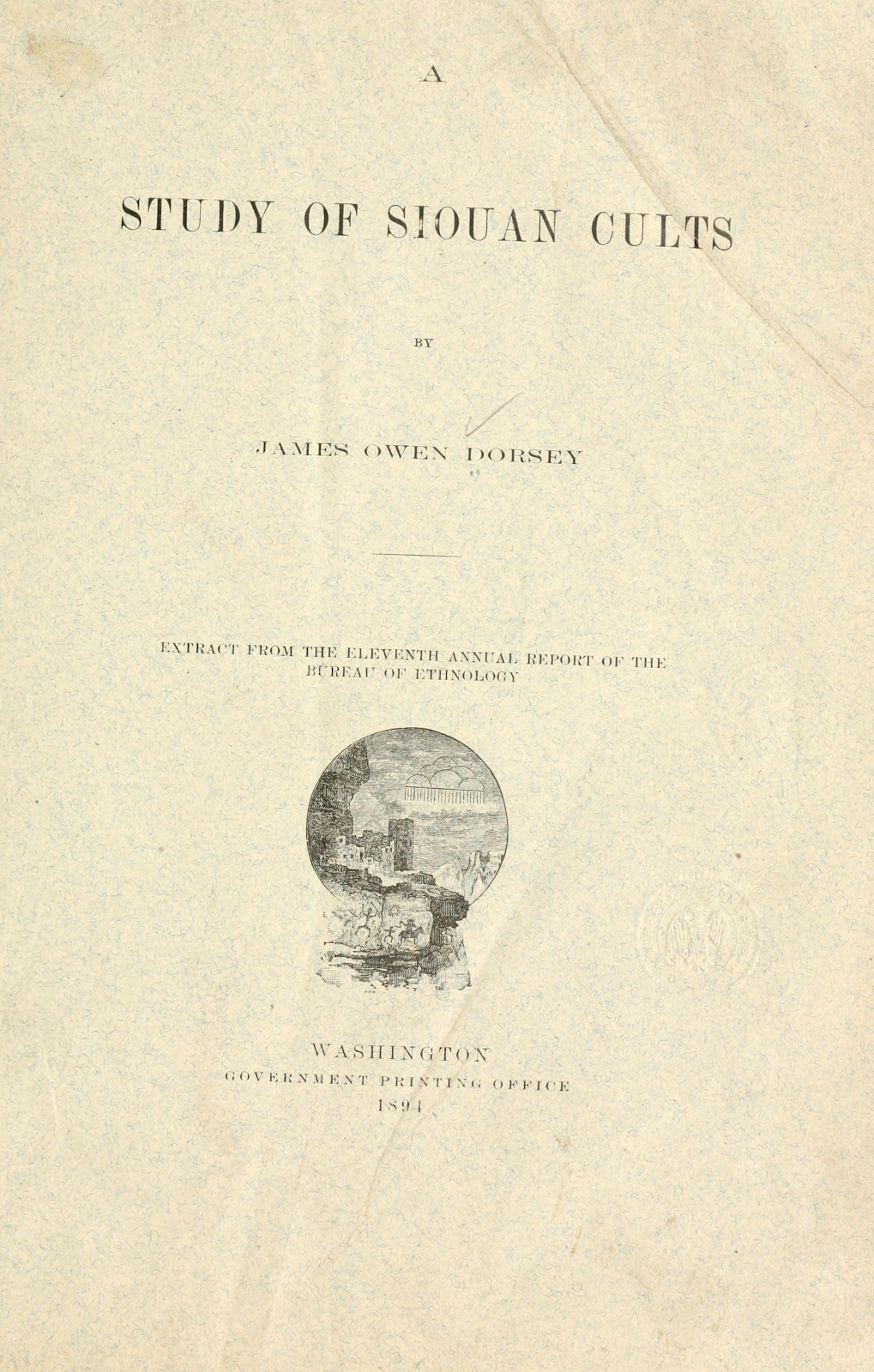
Siouan Sociology by James Owen Dorsey


A few observations from an 1897 Bureau of Ethnology Report.


Regarding chieftainship among the Dakota, Philander Prescott  says: “The chieftainship is of modern date, there being no chiefs before the whites came. The chiefs have little power. The chief's band is almost always a kin totem which helps to sustain him. The chiefs have no votes in council; there the majority rules and the voice of the chief is not decisive till then. On the death of a chief, the nearest kinsman in the right line is eligible. If there are no kin, the council of the band can make a chief. Civil chiefs scarcely ever make a war party.”


·        A common confusion for many trying to understand Indigenous ways is the assumption of “like-for-like.”

·        That is assuming there is a one-to-one relationship between words in a language or concepts in a culture.

·        For example: The word “Power” in English usually connotes force or ability, whereas Comanche “Puha” which is often translated as one-to-one for power, can indeed mean strength, or ability but it is more culturally understood as Power+ that is…

·        He is physically strong AND he is of character.”

·        Or…

·        He knows many game trails AND he has integrity.”

·        Strong is one word, ability is another, character is another.

·        These can run as separate concepts in English or Westen culture but in Comanche culture to possess strength or ability WITHOUT character simply is not Puha.

·        Strength without Puha is nothing to be admired.

·        Power in the Western sense is Instagram-worthy whether or not the poster possesses any admirable character traits.

·        An alien concept in the Comanche way.


“In all these tribes there is no such thing as hereditary rank. If a son of a chief is wanting in bravery, generosity, or other desirable qualities, he is regarded merely as an ordinary individual

·        Again, alien to Western culture founded upon bloodlines, royalty and fealty to family names: Kennedy et al.


To preserve his popularity a chief must give away all his property, and he is consequently always the poorest man in the band.”

·        Again, alien to the Western concept of Power where enrichment and elevation of the material aspects is part and parcel of power.

·        In the Plains tradition and the eastern woodlands potlatch culture, power is signaled by service, by generosity, by the ability to sustain with less rather than “Gimme extra cuz I’m important.”


Power is tacitly committed to the leading chief, to be held so long as he governs to general satisfaction, subject, however, to the advice of the soldiers.”

·        As long as Wisdom and good judgement is demonstrated, the role of Chief continues.

·        As soon as the Wisdom deviates—termination of services.

·        Power, Puha rather is contingent on ability not repute of ability or remembrance of past successes.

·        We are what we are with each act.

·        No fealty to the office.

·        All fealty is to the service.


Age, debility, or any other natural defect, or incapacity to act, advise, or command, would lead a chief to resign in favor of a younger man.”

·        Notice it is not just age, but any infirmity or failing.

·        There were aged chiefs.

·        There were chiefs that possessed crippling bodily injuries who still served well.

·        As soon as these or any infirmity [lack of courage, indecisiveness, failure to lead to good game, etc.] manifested, the chiefdom was at its end.


Seems there is much to be learned from “A heathenish People savage and untutored.”


Thursday, December 19, 2024

Last Scout by Wade Everett


“Another thing too,” he said. “A man picks his work because he is what he is. When a man ain't afraid to try himself, to find out what he is, he'll take a job with some risk. When he ain't man enough to do that, he clerks in a store, or counts plews another man fetches to him. It's always been that way, boy. Back in the days of the fur trade, them rich titled fellows would come out and run the tradin’ posts. They'd faunch about in knee britches and sniff snuff and keep books. Then go back to New Orleans and tell what a tough time it was, how cold it got in the winter.” He laughed. “They thought they was livin’, boy, but the livin’ was a far piece out, to a place they'd never see, on account of it took a man to just get there. You see them far places, boy. You go when the itch gets you, and don't come back till you've seen it all.”

We stopped in front of the express office. “You're an old pirate, grandpa.” He took it the way I meant it, as a compliment, and he gave me a near toothless grin, “Yeah, I've bayed it the moon and made a couple of trips to hell just to see what it was like down there. But I got no regrets. Life’s a strong taste, boy, and only a few are man enough not to choke on the sweetness of it, or wretch on the gall.”

My second Everrett [Will Cook] novel after the excellent First Command [also reviewed here.]

In comparison it is the lesser of the two.

That fault may be mine; it is from the POV of a boy which gives the novel the feel of a “young adult” effort.

That does not prevent Everett/Cook from providing enjoyment and…

A good amount of Wisdom with a capital W.

As in this example…

“It don't bother man to die when he knows he's doing somethin’. It only bothers him he knows all that's left is the dyin’.”

Or this one…

“A man is what he is from moment to moment. What he's been doesn't count, and what he's going to be ain't worth a hill of beans. Just this moment, that's what we are, no more.”

It may be “lesser” Everett/Cook but I still enjoyed the hell out of it.

Thursday, December 12, 2024

Stories of Christmas and the Bowie Knife by J. Frank Dobie


“The gift without the giver is bare.” Gifts can be manufactured, some beautiful, many useful, but giving-out feelings can’t be—though they can be cultivated. The love and cheer associated with Christmas will always be the best thing about it. How often just a good word that conveys the word-giver’s generosity of spirit enriches people! I remember the “Merry Christmas, sir!” of a gray-haired woman scrubbing stone steps at a college in Cambridge, England, during the war; and recollection of her sturdy, cheerful, kind nature brightens my world. I can hear my mother’s “Christmas Gift” or “Merry Christmas” as I write these words. Whoever heard her greeting received a gift, for she meant every syllable of it, felt every tone in it. Sunrise, starlight, silence of dusk are never trite. Generous feelings and cheering words are never trite. Merry Christmas!

A brief volume from Western historian Frank Dobie.

I adore Mr. Dobie’s work [some of which is reviewed on this blog] and t’is the season for Christmas tales so…

The first half, our Yuletide section is more a terse remembrance than a narrative—sweet but not essential.

As for the second half of the book regarding the legendary Jim Bowie and his fabled knife…

It is good folklore but has little to do with actual history.

Dobie presents it as such so there is no quibble with him “making claims.”

It is a brief twofer volume—again not essential but I am not sorry at all I spent a little time with it.

Merry Christmas!


Friday, December 6, 2024

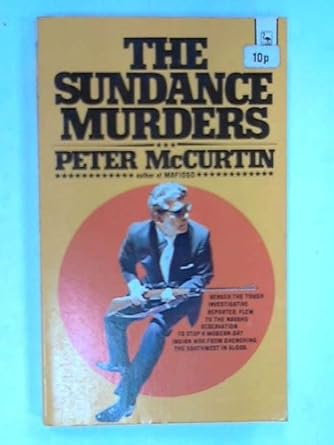
The Sun Dance Murders by Peter McCurtin


I drove through places you never heard of Flora Vista, Kirkland, Shiprock. There was no air conditioning in the car, and it was at least as hot as hell. At Durgin Springs I stopped to have a look at the wrecked post office. I talked to two of the survivors, both local whites, but there wasn't much they could tell me.

A Neo-Western from 1970. Seems to be a mix of Mickey Spillane transported to Elmore Leonard’s Southwest Mr. Majestyk territory, add some Billy Jack American Indian Movement politics, fake “red man” mysticism and you have a potent mix of some very un-PC seventies era sex, violence, casual racism and beaucoup misogyny.

I can get behind such vibes often—I find S. Craig Zahler’s excesses works of art.

Here, though,…here, while written with brisk craft, the non-stop “I’m a lady-killin’ bad-ass” narrative becomes laborious.

In a short dose, perhaps, but we are expected to follow these adventures for 156 long pages.

Our hero is so damn Manly there is never a doubt that all of the feminine species will throw themselves at him and all males of the species will be intimidated and/or laid low in bursts of violence.

I might have enjoyed this one far more when I was much younger and read the first few Mack Bolans with avid attention.

I am no longer that younger me.

If everything here that turned me off to the book sounds like your cuppa, well, giver ‘er a go.

Not badly written, just too much…way too much.

The Devil’s Triangle & Fraudulent Research, Part 3

  [Here she be, Part 3! IF YOU HAVE NOT READ PARTS 1 & 2, well, it’d be silly to consume the blow that follows. Parts 1 & 2 set th...