Monday, April 14, 2025

One Ranger Against a Conman Named Trump


Pump the brakes, this is not a political post.

It is a review of a single episode of a western television series, but…

Depending on your relationship with facts, it either strikes one as prophetic, or grand coincidence, or, at the very least a mighty odd curiosity.

May 9, 1958, CBS airs an episode of Trackdown titled “The End of the World.”

Trackdown followed the exploits of Texas Ranger Hoby Gilman as he righted wrongs in the West of the 1870s.

Gilman was portrayed with cool conviction by the redoubtable Robert Culp.

The episode in question tells the tale of a conman visiting the town of Talpa where he claims that he [and only He] can save them from threats that only exist in his own prognostications.

The name of this doom slinging conman? Trump. [Nope, I ain’t even kidding—the name is Trump.]

The town seems to swallow his venom hook, line and sinker.

The newly arrived Hoby Gilman takes in Trump’s spiel and shakes his head in mute wonder at such utter preposterousness.

His incredulousness is magnified when he looks around him assuming that all see through the transparent clothes of this “emperor”, but his jaw is left hanging open as he realizes those that surround him are hanging on the words of the conman.

Our conman Trump even utters these lines “I’ll build a wall and protect you.”

Our Texas Ranger’s arguments to “Pay attention, use your minds” falls on mute ears.

We move from this fascinating set-up and second act where Hoby Gilman tries to urge folks with reason—to no avail and we end the episode with some standard “Let’s wrap this episode up neatly 1950s”-style shenanigans.

All in all, a slight episode.

In a world where there was no echoed comparison, I’d say the episode’s premise is so preposterous that it seems more like kiddie fare than something programmed for the usually adult themed Trackdown episodes.

But now, well, now the episode strikes one as remarkably prescient, on-point concerning the herd mentality of human nature.

What in most circumstances is a C episode becomes an A+ fascinating curiosity at the coincidences of life.

Politically this episode and review are neuter.

But…like our Texas Ranger, I stand on the side of reason over obeisant swallowing of the palavering of hucksters.

Tuesday, April 8, 2025

Fighting Man by Frank Gruber


He was twenty-six years old, a towhead with washed out blue eyes. Schoolteacher, gambler, horse thief, camp follower, murderer and cannibal; he had been all of them.

The above is the first sentence in this 1948 novel by Mr. Gruber. That succinct matter-of-factness is peppered throughout the brief page run.

The novel follows an old storyline—the outlaw assuming the guise of a lawman.

The difference here, despite the 1948 pedigree, there is a casual violence that one might encounter in later Spaghetti Westerns or “adult” Westerns of the ‘70s.

The other difference, where often the violence in the two later examples I provided, that “modern” violence is often for grand guignol effect, inserted for the “cool” factor. Here its offhanded matter-of-factness serves us better as it seats the realities of true grimness without the need of wallowing for effect.

The difference between a hunter telling a tale and gamers swapping first-person shooter “accomplishments.”

Overall, it is a formulaic novel but an effective one.

I close with another brief offering of Mr. Gruber’s barebones violence.

A sentry stupid from illicit sleep, raised himself between two tents to see what was causing the noise that sounded like galloping horses. His mouth fell open in amazement—and then he died.

Says it all in two short sentences.

·        In war not all are diligent, nor all brave.

·        Some of us are prone to the realities of being a tired human.

·        Bodies need sleep.

·        This sentry slept when he shouldn’t.

·        He awakes as we all do, slow to process what is around us.

·        For that he is surprised by his end.

·        Surprised in a war zone.

·        We all sleep, we are all surprised.

·        T’is life.

·        T’is death.

Solid fare for a “mere formula Western.”

Thursday, April 3, 2025

Gun Hand by Frank O’Rourke


He had no real zest for the job; that was lost in the past and he was beyond the age of eagerness. The old urge for trouble had died in his chest, the once bright game had passed on to younger men.”

That is Mr. O’Rourke describing an aging John McCabe’s view of having lost his taste for plunging into wild ways.

In this blog, I have made it no secret that I consider O’Rourke one of the best in the genre even…even if many of his novels suffer from plots that hew to formula.

I read O’Rourke not for the freshness of the tale [that can occur] but for the riding along for a while inside the skull of a Man who Sees the World.

A Man who Sees the world well.

I won’t offer plot here, that is seldom the way in these pages, rather I will offer another extract.

Here we go from food at a station to ride along on a stagecoach to first viewing of a town.

One paragraph. One.

It tells far more than the words on the page.

He rose early and ate his breakfast at the counter before the other passengers came down, and took his place beside the driver on the top seat, busied himself with a stick on his muddy boots when she came to the door. He rode all day in moody silence that bothered the driver, and eventually pulled them completely apart. He watched the changing land as they galloped north along the river, made their stop at noon to change teams, and galloped on again. Two hours before sunset they swung into a broader road lined with houses and barns and fields. They clattered over a planked creek bridge and swung into a wide street that boasted the business of this town--- eight solid blocks of stores and saloons and hotels, all slapped together in a rush from green lumber, but there to stay and to be replaced by the brick, for this town was a comer. They pushed into the stage yard and stopped and the lassitude that followed so much movement struck them all as they got down and looked about at the town.

One paragraph. More setting, character, and story than many an entire chapter.

Tuesday, March 25, 2025

Winter Count by Barry Lopez


What I remember most from the first visit, however, was neither the dryness nor the cactus but the wind. When I was a child in California the Santa Ana wind that came west to us from this side of the mountains seemed to me exotic but aloof. The wind I found in this upper Sonoran country with my father was very different. It was intoxicating. The wind had a quality of wild refinement about it, like horses turning around suddenly in the air by your ear. Whether it blew steadily or in bursts its strength seemed so evenly to diminish as you turned your face to it, it was as though someone had exhaled through silk. I have never since felt so enticed or comforted by the simple movement of air.

This slim volume of short stories [9 total] by the noted naturalist, Barry Lopez highlights his knowledge Plains Indians and the Land---very much the Land.

Those familiar with Lopez, either thru his work with National Geographic or his nonfiction works Arctic Dreams and Of Wolves and Men can expect the writing quality to be high and the observations of natural phenomenon to be gimlet focused.

That is, indeed, what one finds here.

I will say each story, while interesting, is of the elliptical style, where often the point or even the finale of the story is a bit…lost in the horizon, very much like the horizon of the Land Mr. Lopez describes so well.

At a slim page count [my copy runs 112 pages] and written with clear intelligence, I am not sorry I spent time with it.

I will admit, I am philistine enough to long for tighter plotting once I finish such New Yorker fare no matter how Western or skillfully done.

Wednesday, March 19, 2025

“Trouble Weather” by Lauren Paine


Carter stood up. His height seemed to tower over her. “Your family likes Nevada, doesn't it?”

“Yes. We've had it hard here, but we like it…we're going to stay.”

“Then do something for Nevada. Not just for Will, but for Nevada… for yourselves. Pioneers don't come to a wilderness just to take, ma'am… they come to give.”

“I'll do it,” Mister Alvarado.

My first encounter with the mighty prolific Mr. Paine.

I hardly know if this example is typical, but it struck me as on par with mid-to-late L’Amour: brisk, amiable, nothing deep, and given to a bit of preacher-ness.

Note, not preachiness, which is pushing the lesson a little too hard at the expense of story, but rather Preacherness, where the piece and the point of view seem intertwined.

Without looking around, Dago said, “The Indians used to have, Carter let the deed die with the wind. You go on back to town.”

Overall, a fine story, no roof shaker but fine afternoon fare all the same.

Tuesday, March 11, 2025

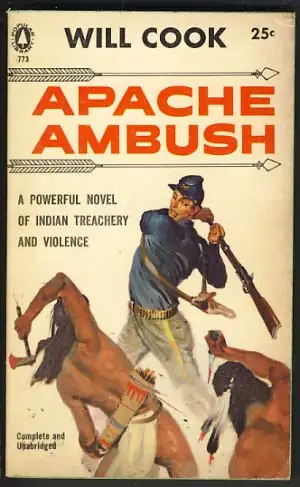
Apache Ambush by Will Cook


Lovington was in the barn, still alive, hanging by his wrists from one of the rafters. The Apaches had sliced through the calf muscles and his feet kept twitching. Another had flicked out Lovington’s eyeballs with the point of his knife. They hung on his cheeks like boiled eggs dangling from bloody strings.

The metallic clank of spurs roused Lovington and he croaked, “Shoot me! In th’ name of God-- shoot me!”

Now that is undoubtedly stark, particularly for a novel penned in 1955.

In Apache Ambush, Mr. Cook dishes up another one of his hyper-competent cavalry procedurals.

The land is right, the protocol is right, the men are dust-caked and hard.

It has predictable formulary elements to it that prevent it from being raised to an A level but the ride along the way is so true to lived experience that is easily head and shoulders above many a formulary tale by others who lack his life-experience.

I read Cook for his starkness and also for his offhand observations of the human character, as in the next extract.

Like many weak men, he easily mistook desperation for courage and this ride, in spite of pain and discomfort, would remain a hallmark in his life.

In my estimation, lesser Cook is what many another western author strives for on their best days.

Tuesday, March 4, 2025

O Pioneers! by Willa Cather


Bergson went over in his mind the things that had held him back. One winter his cattle had perished in a blizzard. The next summer one of his plow horses broke its leg in a prairiedog hole and had to be shot. Another summer he lost his hogs from cholera, and a valuable stallion died from a rattlesnake bite. Time and again his crops had failed. He had lost two children, boys, that came between Lou and Emil, and there had been the cost of sickness and death. Now, when he had at last struggled out of debt, he was going to die himself. He was only forty-six, and had, of course, counted upon more time.

The opening extract from Cather’s 1913 novel is just one of the gemlike observations from this gorgeous novel.

It was offered as one of The 100 Best Western Novels by editor Jon E. Lewis.

It is not your formulary Western chockful of rootin’-tootin’-shootin’ action by any stretch of the imagination—if that is what one requires, look elsewhere.

But…but, if one allows the prose to wash over one, the people with their hopes, dreams, internal frictions in a small Nebraska town come alive.

Cather’s own experience growing up on the plains fuels the reality of what she offers.

Like most of their neighbors, they were meant to follow in paths already marked out for them, not to break trails in a new country. A steady job, a few holidays, nothing to think about, and they would have been very happy. It was no fault of theirs that they had been dragged into the wilderness when they were little boys. A pioneer should have imagination, should be able to enjoy the idea of things more than the things themselves.

Here the rural envies the cosmopolitan, but the tables are turned.

Which are we?

“I'd rather have had your freedom than my land."

Carl shook his head mournfully. "Freedom so often means that one isn't needed anywhere. Here you are an individual, you have a background of your own, you would be missed. But off there in the cities there are thousands of rolling stones like me. We are all alike; we have no ties, we know nobody, we own nothing. When one of us dies, they scarcely know where to bury him. Our landlady and the delicatessen man are our mourners, and we leave nothing behind us but a frock-coat and a fiddle, or an easel, or a typewriter, or whatever tool we got our living by. All we have ever managed to do is to pay our rent, the exorbitant rent that one has to pay for a few square feet of space near the heart of things. We have no house, no place, no people of our own. We live in the streets, in the parks, in the theatres. We sit in restaurants and concert halls and look about at the hundreds of our own kind and shudder."

Ponder this precious diamond of a throwaway line.

People have to snatch at happiness when they can, in this world. It is always easier to lose than to find.

Or this observation in tune with the tides of life.

When she went out into the dark kitchen to fix her plants for the night, she used to stand by the window and look out at the white fields, or watch the currents of snow whirling over the orchard. She seemed to feel the weight of all the snow that lay down there. The branches had become so hard that they wounded your hand if you but tried to break a twig. And yet, down under the frozen crusts, at the roots of the trees, the secret of life was still safe, warm as the blood in one's heart; and the spring would come again! Oh, it would come again!

A truly gorgeous novel.

Wise, mature, observant. Real.

“Fruit Tramp” by Daniel Mainwaring

  [A Labor Day week offering.] Still the fruit tramps came every year when the Elbertas were turning yellow in the shiny leaves. Not so ma...