Tuesday, May 27, 2025

Weird Western Tales: The Black Seer of Death Canyon


This August 1977 issue of the DC Comic is my first foray into the Weird Western series.

I was rarin’ to go for a bit of colorful nostalgia.

In this story by Michael Fleisher, with art by Dick Ayers and Frank Springer we are treated to what I can only assume is an attempt to launch a series character called The Scalphunter.

The Scalphunter is a half-white, half-Kiowa named Ke-Who-No-Tay.

This issue’s scrap is not much above a Hopalong Cassidy adventure with a bit of bloodshed thrown in for good measure.

We are also introduced to Wakwame, the Black Seer who seems to be an additional attempt to launch a Black character in the West ala Marvel’s Luke Cage Power Man hero.

I reckon I’m not qualified to pass judgement on this tale as it was clearly not written with a 59-year-old man in mind.

It seems serviceable comic book fare.

Not sorry I delved.

I likely won’t delve more.

Tuesday, May 20, 2025

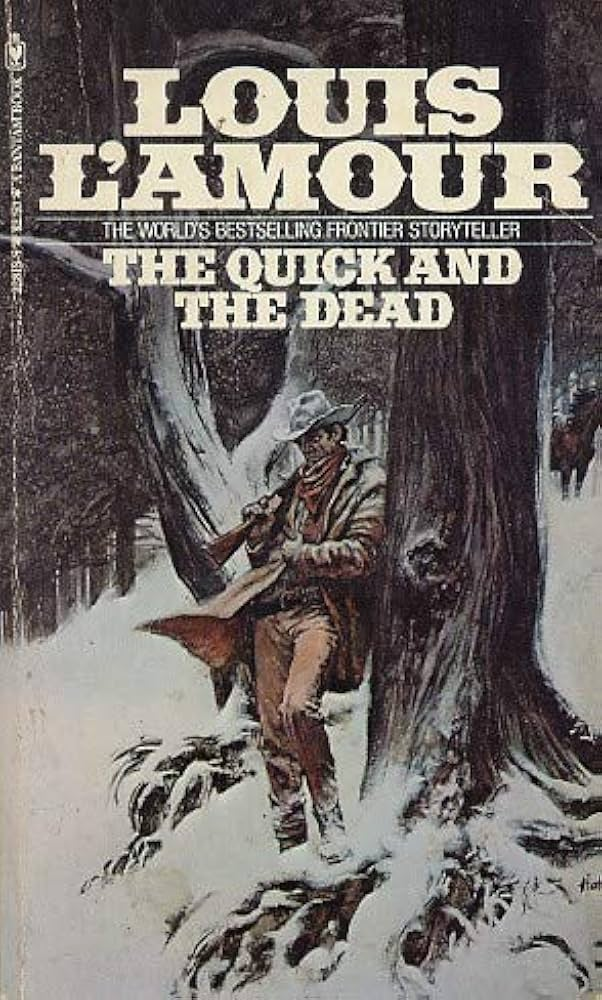
The Quick and the Dead by Louis L ’Amour


You seem willin’ to take the chance. I’ve known folks to cross all the way without seein’ ary an Injun, and others had a fight ever’ day. You face things when you get to ‘em.”

This 1973 novel is a puzzle to me.

Not the plot, meager as it is, that is easily understood.

The puzzle is the utter simple-mindedness this usually on-top-of-it author brings to this tale.

I add, this novel is often considered one of L’Amour’s best—that in itself is a puzzle to me.

Puzzle #1

We are clearly asked to admire the frontier protagonist Conn Vallian who comes to the aid of a Westering family.

The trouble, Conn is not a likable man. As a matter of fact, he behaves not much better than the carboard villains he has come to “save” the family from.

We open with the family in peril—a band of ruffians want to steal their belongings, murder the man of the family and pave their way to taking liberties with the man’s wife.

Our “hero” Conn drops into the mix and commences with droll humor about how the woman is “a sight attractive” and might be “in need of company” once her man is gone.

I believe the author means this as playful banter.

I ask this…if a complete stranger shows up on your doorstep and begins making overtures to your partner—would you find that playful?

Add to it, this stranger shows up in the midst of danger when the husband’s death at the hands of other’s seems to be imminent, the “playful banter” strikes one all the more off-key.

It just doesn’t border on the distasteful it has an air of threat to it.

If the husband dies, would Conn have continued this wildly odd “banter”, or would he make good on his intentions?

Initially, I assumed L’Amour was creating a rarity for him, an insidious villainous presences that the family must also escape. A double-threat.

But, alas, no. We are meant to admire Conn.

The author wastes not a page without a scene that feels would be written in an outline as follows, “Describe an incident where Conn is cool again.”

Puzzle #2

The villains. Long-time inhabitants of this area one would assume. Their motivation for pursuing the Westering family so persistently, so far, and for so long is merely gold.

We are never led to understand why they think this family has this huge cache of gold or just why this single family of greenhorns has been so successful in thwarting these hardmen.

Puzzle #3

The timeline. The family is in a single wagon pulled by oxen—no swift means of travel, one presumably laden with gold and yet, these hardmen on horseback spend the entire novel trying to “catch up” to the family.

For some reason it takes them months to pursue and catch this apparently exceptionally fast oxen-led wagon.

At one point, Conn is out of the picture as he recovers from a wound with a friendly Indian tribe—we are led to believe this took weeks and yet when the plot circles back to the hardmen, they seem not an inch closer to the wagon that is presumably slow and laden with all this assumed gold.

Now, before L’Amour fans write me off as a hater, peruse this blog, I’ve sung the man’s praises here and there, but I gotta call it like I see it—this novel seems like a first draft at best.

I am pleased I did not start my L’Amour reads with this one. Not sure I would have pursued further.

Again, if you love this novel, simply assume I am too uncultured to get the brilliance.

By all means continue to enjoy it.

Consider yourself the winner in this.

For me, it is a puzzling waste of time.

Tuesday, May 13, 2025

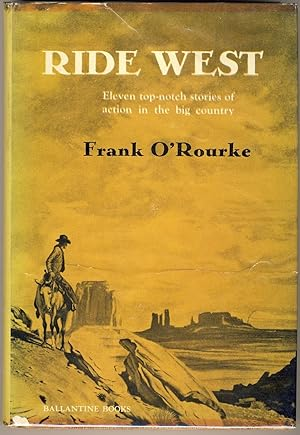
Ride West by Frank O’Rourke


 Edgar Johnson was so big and strong, and so good natured, that people mistook his friendliness for timidity.—Whippletree

This 1953 anthology by an author I hold in high estimation features 11 stories.

Not many can claim to be more than formula tropes but all feature O’Rourke’s mature gimlet eye for life and detail all winnowed to a terse line or two.

As in the following examples.

John Thorpe straightened wearily, chisel in hand, and regarded Gordon with wise, rain-blurred eyes. He saw a thin, wiry man with regular features and black hair already salted gray by experience; a man of thirty or so with an inherent good breeding behind a recent life of unguessable activity.—The Widow’s Peak

Most author’s give us mere, “Here’s what he looked like” and get to shootin’. Mr. O’Rourke tells us what is seen and what lies under the skin.

She was already peering eagerly across the street, and then she saw her husband. Charlie Bourne watched her face break and change into something any man would cherish and be selfish about letting anyone see.—Argument with Death

We know this marriage relationship before we even meet the husband. He does it with a single sentence.

Here is the author in his method.

In my western experiences I've been over every bit of ground I've ever written into a short story or book. I've got a mighty library of the very best fact books on the West, a good many first editions of old books hard to find these days. From my grandmother on my father's side, from my father, from several of his old timer friends, a lot of stories came down to me. I've hunted a lot, have a good many guns, and have also studied old guns of the West, so my characters use the right gun at the right time. You add history as it really was, old newspaper stories, other books, research, and your own general mind picture of things as they were. and I guess that's the way a book comes about.

Mr. O’Rourke sells himself short; all the research in the world don’t make a Man see deeply like he does. That is less research than a Man who Lives, a Man who Feels, a Man who Sees and Remembers.


Tuesday, May 6, 2025

The Investigator by John Sandford


Hawkes’s father had been a white-trash loafer, hard drinker and sometime over-the-road trucker out of Houston. Her mother worked occasionally as a house cleaner and a window-washer for rich people as she tried to take care of her seven children. She took them to church some Sundays and read to them from the Bible some nights, which Hawkes found stultifying and often incomprehensible. The Army, Hawkes thought, was the one way out of that life, if you couldn't afford community college. She was wrong about that; some things that you were born with, you can never escape. She was white trash.

This neo-Western from the impressively entertaining Sandford allows him to feature a new character in the form of Letty Davenport.

Often when an author attempts to concoct a fictional bad-ass, it falls flat as one doubts the bona fides of the author themselves being able to recognize anything in true toughness.

One must live a life to describe it with any accuracy. Too often our fictional “heroes” are echoes of other fictional “heroes” the author has read of.

We can all feel the authenticity when we are offered anything from someone who has really lived or who has really seen.

John Sandford was an award-winning crime repeater. He’s been to crime scenes; he’s sat in SUVs overnight sipping cold coffee with US Marshals. That experience shows.

What is all the more impressive here—he offers us a bad-ass in feminine form and makes her real and all the more formidable than the now cartoonish Jack Reacher.

Letty lives and learns from each step of the investigation—a subtle but too often ignored aspect of fictional exploits.

The plot involves our heroine down Texas-way and a bad of self-styled militia who have something big planned.

No worries, this is not a political novel. It is a novel of “Folks who feel left behind, and we’re not gonna take it anymore.”

It gets the indignation right.

It gets the misguided consequences right.

Mr. Sandford impresses again.

Wednesday, April 30, 2025

Mackinac And Lake Stories by Mary Hartwell Catherwood


Though in those days of the young century a man might become anything; for the West was before him, an empire, and woodcraft was better than learning.—“The Black Feather”

This 1899 anthology of short-fiction center around voyageurs, trappers, and the culture of the mountain and river men of the US-Canadian Border.

The author was exceptionally strong in her historical detail, so much so that no less an authority than esteemed historian Francis Parkman praised her novels for their accuracy, and she was dubbed by some reviewers as “The Parkman of the West.”

Now, onto the prose.

The historical details are correct.

The tales themselves seem to straddle the line between aiming for high accuracy and elevating a bit above “Boy’s Own Adventure Tales.”

While not necessarily compelling literature, if one is an enthusiast of the exploits of the voyageurs of the northern Rivers [and I am] she is fine author to sample now and then.

Tuesday, April 22, 2025

Desperate Rider by Frank O’Rourke


Tony Casper stood at the Colombian bar with his friends, drinking wine, acquiring that tipsy feeling of magnitude. Hat pushed up on jet black hair, accentuating his narrow, handsome face in which his mother's blood dominated, he laughed uproariously at a joke and lifted his glass. This was his element-- the cheap bar, the cheap wine, the friendless friends.

That character description is from the 1959 novel Desperate Rider by Mr. O’Rourke. I’ve said it before, I’ll say it again, the man is practically second to none when it comes to limning a character or even a town in a line.

Where many stick with the physical description, O’Rourke let’s us know his weary opinion of Tony and the Tonys of the world with the single line: This was his element-- the cheap bar, the cheap wine, the friendless friends.

O’Rourke’s characters and towns are seldom all good, or all bad. Seldom are they mere plot pawns, they are human beings or environments that shape the human beings that inhabit it.

The novel plays like a Western version of the classic gangster flick The Desperate Hours. It is a self-contained piece.

While not O’Rourke’s strongest work, there is more than enough intelligence, human observation and fine craft to keep the Western genre appreciator turning the pages.

I’ve said before, Mr. O’Rourke, is one of my favorite genre novelists, even if his work is inconsistent—I still always find something worthy of mulling within.

Thursday, April 17, 2025

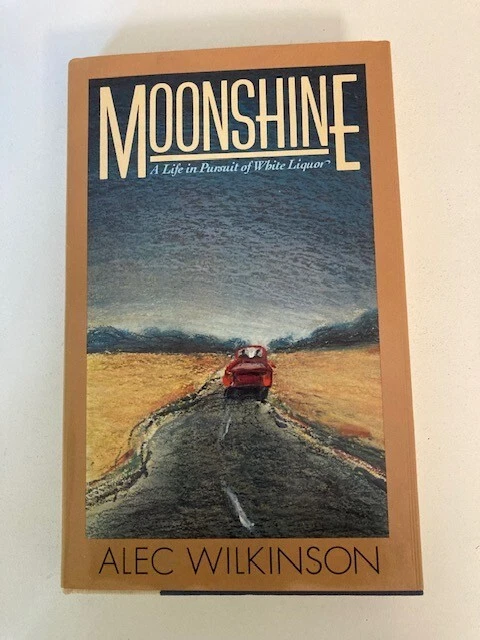
Moonshine by Alec Wilkinson


For more than thirty years Garland Bunting has been engaged in capturing and prosecuting men and women in North Carolina who make and sell liquor illegally. To do this he has driven taxis, delivered sermons, peddled fish, buck danced, worked carnivals as a barker, operated bulldozers, loaded carriages and hauled logs at sawmills, feigned drunkenness, and pretended to be an idiot. In the minds of many people he is the most successful revenue agent in the history of a state that has always been enormously productive of moonshine.

This volume’s full title is Moonshine: A Life in Pursuit of White Liquor. It is a non-fiction work written in 1985.

Wilkinson, our reporter, spends much time with Garland Bunting, a renowned revenuer and raconteur. While not fiction, it reads as smoothy and beautifully as the best of the genre.

Wilkinson has an eye for detail that rings true.

Having grown up in moonshining districts and having known many an extracurricular distributor, hell, I live not four miles from the famed Thunder Road, Wilkinson’s world is A1 authentic.

And I’ve got to mention that he writes like a dream.

It all plays as if Larry McMurtry [or his songwriter son, James] spent time in the milieu of the Deep South drive-in flicks of the 1970s and told you what he saw.

It is deep, sweaty, affectionate and our protagonist drops a line of patter to chew on about every page.

For example:

These folks are suspicious and they'll kill you. They'll shoot the grease right out of the biscuit and never even break the crust.

Along the way you’ll learn more about making and distributing illegal liquor than you ever knew was possible.

It all goes down smooth unlike the product in question.

This one, my friends, is an easy A

It’s called corn liquor, white lightning, sugar whiskey, skull cracker, pop-skull bush whiskey, stump, stumphole, ‘splo,  ruckus juice, radiator whiskey, rotgut, sugarhead, block and tackle, wildcat, panther’s breath, tiger’s sweat, sweet spirits of cata-a-fighting, ally bourbon, city gin, cool water, happy Sally, deep shaft, jump steady, old horsey, stingo, blue John, red eye, pine top, buckeye, bark whiskey, and see seven stars.

In times when the price of sugar has risen high enough to make the use of it unprofitable, bootleggers have substituted molasses. Moonshine made with molasses called monkey rum.

“Fruit Tramp” by Daniel Mainwaring

  [A Labor Day week offering.] Still the fruit tramps came every year when the Elbertas were turning yellow in the shiny leaves. Not so ma...