Thursday, March 30, 2023

“The Clark’s Fork Valley, Wyoming” by Ernest Hemingway


Then there was the winter; the trees bare now, the snow blowing so you could not see, the saddle wet, then frozen as you came downhill, breaking a trail through the snow, trying to keep your legs moving, and the sharp, warming taste of whiskey when you hit the ranch and changed your clothes in front of the big open fireplace. It's a good country.

Here we have something a little different. Not a novel or short-story, or even fiction for that matter.

We have an essay by the inestimable Hemingway that he offered for a 1939 issue of Vogue magazine. [Clearly a different periodical in his day.]

The essay is short but vivid with his telegraph-brief style.

It shows a true love of place.

A love that abides in many of the best works of Westerners.

Brief but beautiful.

Wednesday, March 29, 2023

“A River Runs Through It” by Norman Maclean


Black Jack’s was a freight car taken off its wheels and set on gravel at the other end of the bridge crossing the Little Prickly Pear. On the side of the boxcar was a sign of the Great Northern Railroad, a mountain goat gazing through a white beard on a world painted red. This is the only goat that ever saw the bottom of his world constantly occupied by a bottle of bar whiskey labeled “3-7-77,” the number the Vigilantes pinned on the road agents they hanged in order to represent probably the dimensions of a grave. The numbers are thought to mean three feet wide seven feet long and seventy-seven inches deep. The bar was a log split in two by someone who wasn't much good with an axe, maybe Black Jack himself, but his customers had done a much better job in greasing it with the elbows. Black Jack was short, trembled, and never got far from a revolver and a blackjack that lay behind the greased log. His teeth were bad, probably the result of drinking his own whiskey, which was made somewhere up Sheep Gulch.

Here we have another of “The 100 Best” as chosen by Mr. Lewis. I only speak of the novella having never seen the film.

The offered passage lets us know Mclean has narrative power, it is one of the few sequences that is not centered around fly-fishing.

Much of this story is fly-fishing.

So much of it…

I am not a fly-fisherman, nor a bait fisherman and, initially, I thought my remove from this story was simply I do not share that experience, then I recall, I am also not a concentration camp survivor and have no likewise desire to be one and yet my recent read of Viktor Frankl’s experiences inside several camps was gripping.

This story is esteemed by many, so I don’t think my drop in a bucket minority opinion of, “I kinda wanted a bit less fishing and a bit more coherence in plot when not on the river” will do the story no reputational harm.

If you are a fly-fisherman you may be in hog-heaven with this one.

Monday, March 27, 2023

Concrete Cowboys Starring Jerry Reed & Tom Selleck


Here we have a TV-Movie from 1979 that allows us to ask the question, “What would happen if you took one of John Wayne’s directors, a screenwriter noted for Hammer horror films, Jerry Reed in his Smokey & the Bandit ‘Snowman’ raconteur guise, and added as his Burt Reynolds stand-in, an affable Tom Selleck?”

Well, the answer is this film.

It served as a pilot for a short-lived series that aired in 1981, with Geoffrey Scott taking over the Selleck role.

I’ve not seen the series and can’t vouch for it but…the telefilm is no great shakes plot wise, the duo move through rote Nashville PI machinations but the pair have an undeniable charm and an affable chemistry to them.

I am an unabashed Jerry Reed fan, I regard him as one of THE best guitar pickers who ever lived and am equally charmed by his easy way with a story-telling song and good ol’ boy stage demeanor.

This Southern charisma served him well in his film and television appearances.

Selleck is just as good in a tolerant, level-headed, “Aw, shucks” role.

I’d love to have seen these two work together again in a more solid vehicle.

The film is generic, but the stars work every scene they are in.

Fans of either should find much to admire here.

Friday, March 24, 2023

“The Peach Stone” by Paul Horgan


They all knew, the drive would take them about four hours, all the way to Weed, where she came from. They knew the way from traveling it so often, first in the old car, and now in the new one; new to them, that is, for they bought it second hand, last year, when they were down in Roswell to celebrate their tenth wedding anniversary. They still thought of themselves as a young couple, and he certainly did crazy things now and then, and always laughed her out of it when she was cross at the money going where it did, instead of where it ought to go. But there was so much droll orneriness in him when he did things like that that she couldn't stay mad, hadn't the heart, and the harder up they got, the more she loved him, and the little ranch he'd taken her to in the rolling plains just below the mountains.

This story, one of Mr. Lewis’s 100 Best is a jewel.

It is essentially four characters in an old car making a dusty trip with a box of sadness on the back seat.

Almost dialogue free we spend time inside the heads of each passenger as they see the road and what led them to this journey differently.

I will not tip what is in the box.

The story is magnificently human—Mr. Horgan clearly had an eye that saw humanity in detail and could render it three-dimensions.

Superlative adult fare.

Wednesday, March 22, 2023

“Sixty Acres” by Raymond Carver


He cleaned his teeth with his tongue and squinted in the late-afternoon winter half-light. He wasn’t afraid; it wasn’t that, he told himself. He just didn’t want trouble.

Another choice from Mr. Lewis’ “Best Western Stories of all-Time.”

Well-written?

Without a doubt.

Evocative of mood, place, and character?

On the money.

But…this reader has a low threshold for elliptical endings, stories that just paint scenes in a few broad strokes and simply end.

Yes, much of life is that way, perhaps all—we stop any story at any moment and there are unanswered questions.

But I must admit when I sit down to read I have a plot-trained Pavlovian desire for resolution. For endings that one does not necessarily receive in “real” life.

This reaction to the story is more about me than Mr. Carver’s craft.

Mr. Carver writes with incisive precision; I would have followed it more happily to an ending.

Monday, March 20, 2023

Run, Simon, Run starring Burt Reynolds


This 1970 TV-movie is a contemporary Western starring a pre-superstardom Burt Reynolds.

I am an unabashed early-Reynolds fan and I must admit I had never heard of this film.

Reynolds plays Simon Zuniga, a Papago Indian just released from the Arizona State Pen.

He returns to the Reservation and confronts the changes there and via a quiet stoic remove from the changes, instigates changes of his own.

This film is reflective of the AIM movement [American Indian Movement] and is sharply written, sensitive, low-key and works quite well. Reynolds is all quiet charm here, more reflective of a brooding Steve McQueen or Charles Bronson than the noted wisecracker that he would become.

I sought it out of curiosity but wound up getting far more out of it than I expected.

Dignified and strong with a fine score by The Orphanage.

Wednesday, March 15, 2023

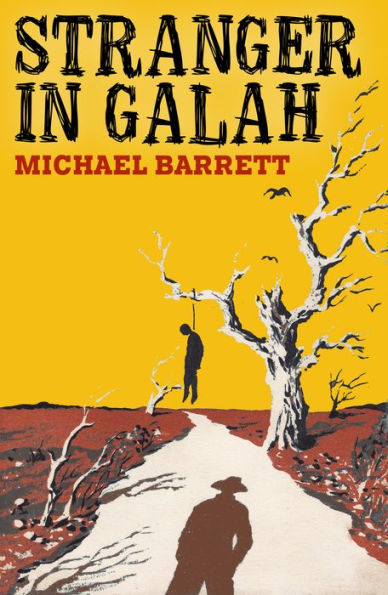
Stranger in Galah by Michael Barrett


They drove on. The atmosphere began to oppress Deane more heavily. Nothing in sight, bare earth and the groups of cattle standing, motionless. The harsh sun poured down over the plain, a white ball of light. When they were close he saw the beasts were mere skeletons, filthy hides draped over their scarecrow backs. They stood gaunt, legs splayed out, unmoving: specter-like symbols of doom and destruction. Only their horns were smooth and unchanged; their great eyes had a glazed, vacant stare. They did not see, they did not hear the car pass. They just stood, trance-like. The woman glanced at Deane. She stopped the car, switched off the engine. Then the silence was something frightening. Absolute, utter silence over the vast paddock and desolate earth. No wind, no movement, no life. The dying animals with the empty eyes. Time stood still, waiting for death. Deane shifted uneasily. One of the cattle nearby went down with slow finality into that long-promised death. It sank to its knees, rolled over with the same complete silence to the bare earth. A nightmare, death-watch quality hung over the scene.

Here we have an “Outback Western” or “Bush Western” or more simply a novel of the Australian Frontier.

Written in 1958 the offered passage tells the power of one aspect of this novel—it has the pervasive punishing drought down pat. The baking heat, the red grit in the teeth, all hold center as characters in the tale.

Also strong, the opening—I will not give it away, but it calls to mind the ruthlessness of the opening of Elmore Leonard’s superior Valdez is Coming.

The opening third held this reader in thrall and then…well, then it seems to spin its wheels in the femme fatale/noir land of the Fawcett Gold Medal Line circa 1950s.

Yes, there were superior authors working in those hallowed paperbacks, but much, if one is honest, is merely rote pushing of sweaty passions around pat checkerboards of repetitive plots.

This plot deals much with race and to do so portrays some characters as callous bigots, which is necessary but…even our protagonist does not come off much better.

There is something patronizing and dismissively paternalistic about the novel. If it had hewed to its opening toughness, it might have weathered these difficulties better, but as it becomes more formulaic the patronizing becomes merely lazy and possibly indicative of true attitudes which is…a bit uncomfortable.

In short, I thought I had an undiscovered classic in my hands for the first two thirds of the novel and then…well, there is still skill here. There is power.

A power that fails in the end for this reader.
The Devil’s Triangle & Fraudulent Research, Part 3

  [Here she be, Part 3! IF YOU HAVE NOT READ PARTS 1 & 2, well, it’d be silly to consume the blow that follows. Parts 1 & 2 set th...