Tuesday, August 16, 2022

Mojave Guns by Roe Richmond


They jogged onward in the eerie brilliance of moonlight and starshine, breaking the stillness with the chop of hoofs, the rustling creak of leather, jingling bridles and clinking metal, the grunt of horses and the breathing of men. Alkali dust spiraled up, and shod hoofs struck occasional sparks off the stones. A coyote howled sorrowfully and was answered from afar. An owl hooted and then another. When Raven halted the column, they could hear the faint stir and scrape of small earth creatures. The air smelled of blistered sand and rock, greasewood, sage, and once in a while the pure breath of pines.

My first by this author, and a curious one for me. That opening selection is typical of the excellent renderings of scenery and the punishing feel of conducting campaigns in such conditions.

Yet, most all else is a fairly rote cavalry tale related almost indifferently, that is, compared with the skill shown in the “Men in landscape” sections.

The author shows such skill in some sections, and then seems rushed and detail skipping on others.

Most curious in that the demerits are not from lack of ability.

Not at all.

Another selection.

The sun soared higher in the molten blue, and the heat became barbarous, brutal in its intensity. Drenched in sweat, silted Confederate gray with dust, the column toiled on across the barren broken plains of Hellsgate toward the principal range of the Osages. Girths frothed white, saddle-leather scorched through uniform pants, rifle barrels burned the most calloused palms. Lips were parched and split to the texture of scar tissue, each lower one with its central gash, eased only by leaves of chewing tobacco. Eyes sank ever deeper into blackened, hollow-cheeked skulls of faces. Misery grew in the harassed ranks until death seemed almost welcome, if it could come in one quick flash.

Again, the land lives and breathes in a way that the people within do not.

Most curious.

Wednesday, August 10, 2022

Robbers by Christopher Cook


Ray Bob said, You ever watch westerns? That sounds just like a line out of a western. Outlaw shows up to see his old runnin buddy, and the little woman says, He’s changed. He don’t want your kind of life no more. Why don’t you just go on, leave us alone? And if he’s a good outlaw, he understands and rides off and you feel sorry for him, being all alone again. But if he’s a bad outlaw, he hangs around waiting, playing with his gun, making her all nervous. Ever notice that?

Here we have a Neo-Western complete with outlaws and a dogged Texas Ranger. It is unapologetically violent, but there is no “romance of violence” here. It portrays violence for what it is, stark and senseless.

Even our “heroes” are reflective of real-life, nobody’s perfect and often those we ask to protect and or fight for us may not fit the “shining armor” ideal but…they sometimes get the job done.

“You the first Ranger I ever met, he said. Rule grinned. Well, they say we’re something special. That’s PR mostly. Deep down inside, I’m the same as anyone else. The sheriff hooked his thumbs in his gunbelt. Nodding thoughtfully at the apparent sagacity of that remark, at its implied candor. I’m a regular sonofabitch, Rule said. Why I work alone. Nobody can stand me.”

The novel is no mere genre piece, it approaches literature without straying into pretension.

It stands in the middle-ground between Stephen Hunter’s elevated noir of Dirty White Boys and Cormac McCarthy’s No Country for Old Men.

The novel can be thought of as Hell or High Water without the redeeming motive.

Along the way we are treated to ideas that bring one up short as in this observation from a Texas honky-tonk owner.

Cause you a roots man, Bubba Bear was saying, off on another run, cause you’re not modern, post-modern, avant pop, all that wonka-wonka jive. World’s gone theoretical, friend, vicarious and abstract. Image over substance. Folks bored of the real thing, not that they see it much. They disconnected from the past, their own nature. But not you. Am I right or wrong? Eddie said he reckoned so, one way or the other. Bubba Bear grinned. You’re sharp, Rufus, you got that inborn native intelligence. Comes from having your feet on the ground. All that black Mississippi mud between your toes, the wisdom of the gut. You’re not a spectator, man, you’re a creator. I built my soul a lordly pleasure-house, wherein at ease forever to dwell. That’s Tennyson. I celebrate myself and sing myself. Whitman, another roots man. What I’m saying, friend, is you’re too busy creating the universe to pay attention to the ancillary bullshit. You’re rooted. Otherwise you’d be living secondhand sucking off TV and pop music, reading People magazine, have a soul about as big as my left nut. Know what you’d be? Eddie allowed he wasn’t sure but had a notion. That’s right, Bubba Bear rolled on, a consumer. A corporate subject. Someone whose sole allegiance is to money. Someone who lives within the borders of his debt in permanent exile. Make it, spend it, finance the difference, living on the installment plan. Eats what they throw at him, says yum-yum. Garbage, his only creation.

An unapologetically real journey.

Highest marks for this reader.

Friday, July 29, 2022

Finding Nevada by Frank Roderus


Now he thought that the position in the bank was a nice position for a man to have. He enjoyed the work and he enjoyed the people, and if the officers of the bank did not really understand that Harrison’s popularity with the patrons came not from his efficiency but from his genuine liking for them, well, that was the bank’s problem. Harrison did not truly care all that greatly how they perceived him. The fact was that he thoroughly enjoyed what he was doing.

This novel is a fine example of what I can enjoy about the genre—despite the pictured gunfight on the cover [my cover, at least], there is not a gunfight to be found within.

It is a novel of amiable, loping charm. Most genres exist for the mere sake of the plot itself no matter how skillful people maybe limned along the way. A crime novel with no crime is no crime novel. A mystery with nothing to solve is no mystery. A horror with no shudder is, well…

The Western can be rife with gunfights [and I’ve enjoyed many of that variety.] It can also be one of seeming slightly plotted nothingness and yet still survive because of the caliber of the people we spend time with.

This novel is no rafter-shaker but I am mighty refreshed by having spent a few hours in such amiable unargumentative company.

Wednesday, July 20, 2022

Leaving Cheyenne by Bill Brooks


“I counted the graves of my friends and it was like ticking off time, each one representing a memory, a good time, a shared glass of liquor, a laugh, a sense of indescribable loss.”

The above is a gorgeous representation of what one finds between these covers. It is part of the Quint McCannon series, and I’ll be honest, series usually rate low for me as the very fact that something is a series means that absolute jeopardy is not on the table. The author must continue the character to maintain the income. That foregone conclusion often leads me to never fully involve.

Don’t get me wrong, there are many fine reads within series tales; I simply point out that we all kinda, sorta know the end before we start.

With all that said, this novel has the heft and beauty of a single piece of literature. Mr. Brooks peppers the tale in the fashion of the late Mr. McMurtry where we come across actual historical personages, which allows McCannon/Brooks to proffer his judgment of the figure in question.

A gorgeous tale I enjoyed thoroughly save for the foregone conclusion of “All will be right in the end” before I even left the first page.

I shall return to Mr. Brooks and Mr. McCannon.

Wednesday, July 6, 2022

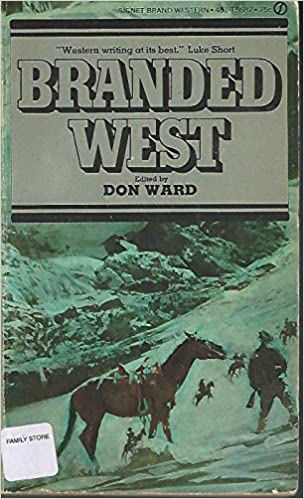
Branded West, Edited by Don Ward


Here we have a 1955 anthology sanctioned by the Western Writers of America.

We are treated to 14 solid tales from the pens of men as able as Elmore Leonard, Stephen Payne, Kenneth Fowler and other practitioners from the early ‘50s.

The volume opens with “The Builder of Murderer’s Bar” by Todhunter Ballard, a story that was selected as one of the 100 Best Western Stories of all time by Jon Lewis.

Usually I concur with Mr. Lewis’ opinion, but I’ll split here—it struck me slight. Likely my error and not Mr. Ballard or Mr. Lewis.

The remainder of the fare is solid, with one easily taking high honors to my taste, that tale being “The Marshal and the Mob” by Will C. Brown—stick to your ribs stuff.

While not essential, I am a sucker for anthologies as it gives one a chance to sample bite-size appetizers of many authors to see if you’d like to delve deeper into their longer works.

Friday, May 6, 2022

Murphy by Gary Paulsen


Murphy edged in the saddle so his gun was handier. He hated shooting off a horse. One of the times he’d been hit he’d been on a horse; he’d fired a shot and the damn horse had gone hog-wild on him. While he was trying to stop it and get another shot off, the man he had been shooting at used a rifle and put a .44-40 bullet through his right thigh. The bullet had gone on through and killed the horse—broke his back. Even though Murphy had been able to get a shot into the man’s pump and put him down, he still hated shooting off a horse.

Primarily known for his Award-Winning young adult novels, Hatchet being a notable example, Paulsen turned in a string of mature Westerns featuring a character by the name of Murphy, this novel being the first in that series.

So, how does a “children’s author” fare in this adult world?

Mighty damn good.

Murphy is a real flesh and blood human being. He is no cardboard cutout hero. He has doubts, unacted upon desires, he suffers the pangs of everyday living and yet he still rises to the job of being a lawman in a small mining town.

Here Murphy is confronted with the rape and murder of a young child, adult fare indeed.

The outrage is handled well, as is the stab at early crime scene investigation.

Handled even better, and the heart of the novel, is Murphy’s affairs of the heart with a local widow.

This is all done with easy assurance.

But…what makes this novel less than an A [for this reader] is the plot resolution. It feels hurried. It feels as if Paulsen enjoyed the widow and Murphy and the time with them so well that he rushed to get past the incident that set the entire novel in motion.

I get Paulsen’s rush, I too, wanted more of Murphy and the time spent inside his experienced skull is akin to spending time around a fire with an old hand wise to many ways and honest to those he does not know.

The shoot ‘em up ending feels out of place in such an assured work.

Still, I look forward to spending more time with Murphy in the next volume.

Wednesday, March 30, 2022

Guide to Life and Literature of the Southwest, with a Few Observations by Frank Dobie


Nobody should specialize on provincial writings before he has the perspective that only a good deal of good literature and wide history can give. I think it more important that a dweller in the Southwest read The Trial and Death of Socrates than all the books extant on killings by Billy the Kid. I think this dweller will fit his land better by understanding Thomas Jefferson's oath ("I have sworn upon the altar of God eternal hostility against every form of tyranny over the mind of man") than by reading all the books that have been written on ranch lands and people. For any dweller of the Southwest who would have the land soak into him, Wordsworth's "Tintern Abbey," "Ode: Intimations of Immortality," "The Solitary Reaper," "Expostulation and Reply," and a few other poems are more conducive to a "wise passiveness" than any native writing.

That title tells you right up front—This is a Reference Work.

What that title does not tell you is that it is beautifully written and full of pith and trenchant observation.

It is, essentially, a list of historical and non-fiction works on the West, with a heavy focus on the Southwest. There are fictional works sprinkled here and there.

Mr. Dobie has apparently read it all, has an opinion on all, and is a wise guide with an observation ever at hand.

Most books of this sort are meant for browsing, but this reader was charmed almost immediately, and I read it cover to cover as if it were hot-off-the-presses fiction.

The volume is manna for historians and researchers, or fiction writers looking to add authenticity to their tales, and simply those who love good writing and mature opinions voiced in a frank manner.

Easily one of the best reference works of its kind.

The Leatherstocking Saga by James Fenimore Cooper, Edited by Allan Nevins

  Actually, the full title is… Being those parts of The Deerslayer, The Last of the Mohicans, The Pathfinder, The Pioneers , and The Prair...